July 30, 2026
Bonuses come up in almost every compensation project I work on with nonprofits, and the conversation usually starts the same way: “Can we even do that?” Followed quickly by: “Should we?”
The short answers are yes, but it depends on what problem you are trying to solve. Here is the longer answer, starting with the headlines.
The Short Version
- Bonuses are legal for nonprofits. The IRS cares about total compensation being reasonable, not about the label on the check.
- Purpose comes first. Most nonprofits that say they want a “performance bonus” actually want recognition or retention. Those are different programs with different designs.
- Fix base pay first. A bonus on top of below-market salaries is a patch, not a strategy.
- Flat dollar amounts usually beat percentages. Percentage-of-salary bonuses quietly amplify every pay gap you already have.
- Fund it before you promise it. The fastest way to erode employee trust is a bonus program the budget cannot support.
- Write it down. If staff cannot explain how bonuses work at your organization, you do not have a program. You have a rumor.
Yes, Nonprofits Can Pay Bonuses
Let’s clear the legal question first, because it trips up some boards/leadership teams before the real conversation starts. Nonprofit employees can receive bonuses. What the IRS requires is that total compensation, salary plus bonus plus benefits, be reasonable for the role and the market, and that no part of the organization’s net earnings flows to private individuals as something resembling profit.
In practice, that means a few guardrails. Keep total compensation defensible against market data. For executives and other insiders, have the board or a committee approve compensation using comparable data, and document the decision. And avoid bonus formulas tied to a percentage of revenue or fundraising totals (e.g. for a Chief Development Officer or Major Gifts Officer). Those arrangements draw IRS scrutiny, and for fundraisers specifically, percentage-based compensation violates the Association of Fundraising Professionals code of ethics.
How Common Are Bonuses, and How Big?
Before deciding whether bonuses belong at your organization, it helps to know what the rest of the sector is actually doing. Reliable numbers are harder to come by than you might expect, because most compensation surveys cover different slices of the field. But the picture across recent studies is fairly consistent.
Bonuses are a minority practice, but not a rare one. BDO’s 2023 benchmarking survey of more than 500 nonprofits found that 42 percent include an annual incentive or bonus in their executive director’s compensation. Studies that look across whole staff rosters land lower. A 2024 study of 107 nonprofits found about a quarter paying performance bonuses to CEOs and mid-level managers, with bonuses for entry-level employees still uncommon, and The NonProfit Times’ 2025 salary and benefits data shows roughly 30 percent of organizations paying a bonus for a typical administrative role. That aligns with compensation studies I’ve done in the past in the affordable housing and education sectors, where typically 1 of 4 orgs will have a universal bonus program open to all staff.
Size and sector drive the differences. In that 2024 study, 40 percent of organizations with more than $8 million in revenue paid CEO bonuses, against 10 percent of those under $250,000. BDO found that business and trade-related organizations put a larger share of total compensation into incentives, while education and health and human services organizations rely almost entirely on base salary. Incentive pay is also more established in hospitals, higher education, and large national organizations with dedicated HR functions.
Amounts are modest by private-sector standards. Staff-level bonuses tend to run in the low single digits as a percent of salary. In The NonProfit Times data, the average payout for administrative roles was about 2.4 percent of salary, with maximums around 11 percent. Executive bonuses run larger, and Nonprofit HR has reported incentive bonuses reaching $20,000 to $30,000 at mid-size and large organizations. Organizations that budget for incentive pay typically spend around 2 percent of their operating budget on it.
So if you are considering a program, you would not be an outlier in either direction. Roughly a quarter to two-fifths of nonprofits use bonuses in some form, most keep them small, and the practice is growing. The numbers also carry a quiet lesson: the organizations most likely to run bonus programs are the ones with the budget capacity and management infrastructure to support them. Which brings us to the question that matters more than what everyone else is doing.
Start With Purpose, Not Mechanics
The most common mistake I see is starting with design questions, how much, what percentage, what metrics, before answering the only question that actually determines the design: what is this program for? What behaviors do you want to see more of? Less of?
There are four general answers, and they lead to four different programs.
- Recognition. You want to say thank you for an unusually demanding year or a standout contribution. This calls for modest, flat amounts, broad eligibility, and no elaborate metrics.
- Retention. You are worried about losing people you cannot afford to lose. This might mean targeted retention agreements with specific dates and amounts, not an annual program at all.
- Shared success. You want everyone to benefit when the organization hits its goals. This is an organization-wide bonus tied to a small number of clear, pre-announced measures, with everyone receiving the same amount or the same treatment.
- Individual performance. You want to pay top performers more than others. This is the hardest to do well in a nonprofit, and I say that as someone who has built many of these systems and did my graduate degree studying incentive programs for public school teachers. Mission work rarely produces clean individual metrics, most nonprofits lack the management infrastructure to rate performance consistently, and differentiated bonuses without that infrastructure become a referendum on who the boss likes or who is most able to advocate for themselves.
Most organizations I work with, when pressed, want some blend of recognition and shared success. That is good news, because those are also the simplest and most equitable structures to run.
The Design Choices That Matter
Eligibility. My default position is that if you offer a bonus program, make everyone eligible. Programs limited to leadership send a corrosive message in mission-driven organizations, and they are where equity problems concentrate. If you have a genuine reason to treat groups differently, such as a separate retention agreement for a hard-to-replace role, handle it separately and be able to explain it.
Sizing. Percentage-of-salary bonuses feel fair because everyone gets “the same” percentage. I don’t think they are. Five percent of the executive director’s salary and five percent of the program coordinator’s salary are very different checks, and the structure compounds whatever gaps already exist in your salary schedule. For recognition and shared-success programs, flat dollar amounts are cleaner, more equitable, and easier for staff to understand. Save percentages for cases where you have a specific reason to scale with salary and can defend that reason out loud.
What it is tied to. Organization-wide goals are easier to measure, easier to communicate, and far less vulnerable to bias or gaming than individual ratings. If you use individual or team components, keep them simple and make sure the people applying them have been trained to apply them consistently.
Equity and Transparency Are the Whole Game
A bonus program is a trust exercise. Staff will judge it not by the amounts but by whether they understand it and believe it was applied fairly.
That means the criteria, eligibility rules, timing, and amounts or formulas should be written down and shared before the performance period starts, not announced after the fact or midway through the year. It means someone should run the numbers by role, salary band, and demographics before checks go out, because discretionary programs can drift toward inequity without anyone intending it. And it means resisting the fully discretionary “surprise” bonus. It feels generous the first time, but by the third year it can turn into an opaque system that staff are reverse-engineering in group texts or private Slack channels.
Before You Tie Bonuses to Performance Reviews
One more design question deserves its own section, because it is one that organizations often underestimate. The moment a bonus rides on a performance rating, every conversation in your performance management system changes.
Performance management, at its best, is a feedback and coaching system. Managers name what is working and what is not, staff can hear it without their paycheck on the line, and the conversation is about growth. Attach a dollar figure to the rating and the pressure shifts. A rating that was a development tool becomes a negotiation. Managers inflate scores to protect their people, or to avoid delivering a hard message with a check attached to it. Staff may learn to steer their goals toward what is measurable and safely achievable rather than what matters most. Before long, both sides are managing toward the bonus number they want for the year, and the system stops telling you the truth about performance.
This does not mean pay and performance can never be connected. It means the connection is a system you have to staff for. You need a genuinely skilled practitioner, an HR director or a Learning and Evaluation Manager, who builds the system deliberately, monitors it closely, calibrates ratings across managers so the same work earns the same score, and cross-trains and supports managers so feedback stays honest when money is on the table. That is a real, ongoing investment, not a policy you write once and file away.
If you do not have that capacity yet, that is not a failure. It is a reason to choose one of the structures that does not run through individual ratings, recognition or organization-wide designs, and to let your feedback and coaching system keep doing the job only it can do.
The Money Question
Bonuses belong in the budget as a line item, planned during your normal budget cycle and approved with everything else. If board approval is required for executive compensation, build that into the calendar.
Then answer the question every staff member will eventually ask: if we hit the goals, is the bonus guaranteed? There is no single right answer, but there is a wrong one, which is silence. If payment depends on the organization’s year-end financial position, say so explicitly and in writing from the start. A conditional bonus communicated clearly is fine. A bonus that staff believed was promised and then vanished does more damage than never offering one.
One more budgeting note: bonuses are one-time costs, which is exactly why financially cautious organizations like them. Unlike raises, they do not compound. That is a legitimate advantage. It becomes a problem only when bonuses substitute for the base salary adjustments your market position actually requires.
Getting Started: A Practical Sequence
If you are considering a bonus program, here is the order of operations I recommend.
- Write the purpose in one sentence. “We want to demonstrate our commitment to investing in our staff when the organization has a strong year” is a design brief. “We should do bonuses because our peers are doing it/we had them at my last org” is not.
- Check your base pay first. If salaries are below your market and philosophy, fix that before layering on bonuses.
- Choose the structure that matches the purpose. Flat-dollar and organization-wide for recognition and shared success. Save individual differentiation until your performance management can carry the weight.
- Set eligibility broadly. Default to everyone, and document any exceptions.
- Put it in writing. Criteria, timing, amounts or formula, and the funding conditions, including what happens in a lean year.
- Budget it and get it approved. Through your normal cycle, with board involvement where required.
- Communicate before, during, and after. Announce the program before the period starts, remind people how it works midyear, and explain the outcome when decisions are made.
- Audit and adjust annually. Review the distribution for equity (at least: race, gender, disability status, tenure, and org level), ask staff whether the program is working, and be willing to adjust or simplify.
- Consider timing. Staff usually appreciate having a little cash in their pocket around the December holidays, but it’s fine to align them to your fiscal or academic year if that aligns better with your budgeting or performance management system.
The Bottom Line
Bonuses are a tool that supports a strategy, not a strategy unto themselves. Used well, they let a nonprofit share a strong year with the people who produced it, without locking in costs the next budget cannot carry. Used carelessly, they can create entitlement, opacity, quiet inequity, and erosion of trust. The difference is rarely the dollar amount. It is whether the organization did the unglamorous work up front: naming the purpose, writing down the rules, communicating clearly up front, funding the promise, and checking the results.
Reach out if your organization is thinking through this decision — I’m happy to share both examples of success and lessons learned from building these kinds of programs. ben@thrulinecomp.com
March 12, 2026
Can you trust AI to tell you if you’re underpaid? I ran a structured experiment to find out, and the results should make you think twice before negotiating based on a chatbot’s number.
Headlines Up Front
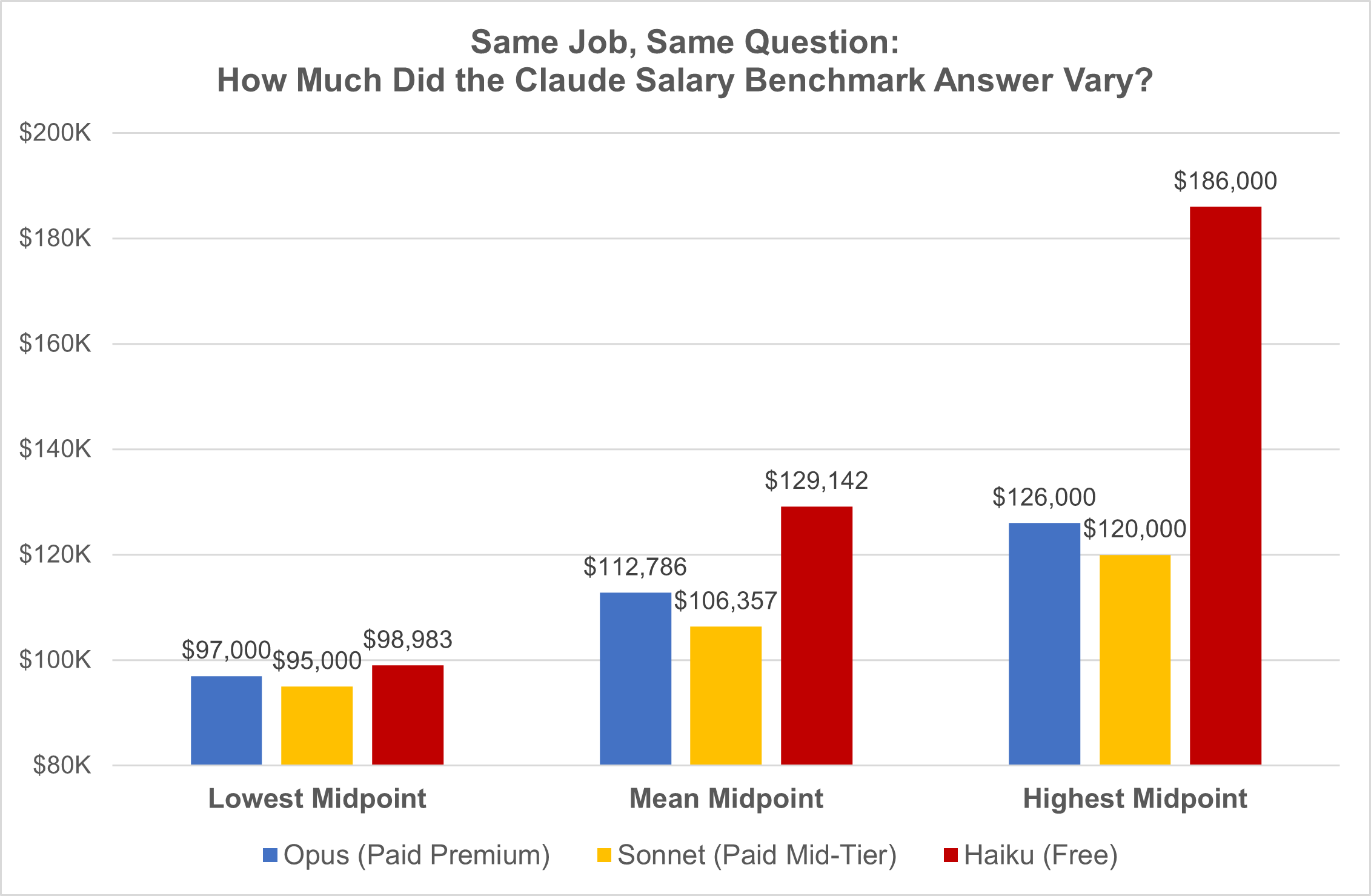
- The spread: Claude’s salary midpoint for the same job ranged from $95K to $186K across 42 queries. That’s a $91K gap.
- Free vs. paid: The free model (Haiku) had 2.5x more variability than the paid models. Its answers are essentially random.
- More detail isn’t always better: Moderately detailed prompts produced the tightest results. Pasting a full job description actually made things worse.
- Built-in randomness: The same prompt, same model, different day produced answers that varied by up to $61K.
- Best configuration: Sonnet 4.6 with org budget, role level, reporting line, and team size returned a perfectly reproducible $115K midpoint.
- The takeaway: AI is a conversation starter for salary research, not a source of truth. Use real compensation survey data for anything defensible.
The Experiment
I tested three versions of Anthropic’s Claude (Opus, the most powerful; Sonnet, mid-tier; and Haiku, the free model) on a single question: What is the market salary range for a Program Manager at a nonprofit in San Francisco?
I asked 42 times across 7 progressively detailed prompts and 2 separate sessions per model. Opus and Sonnet ran on my paid account; Haiku on a free burner account. Every session used a fresh incognito window to avoid memory. Same question. Same role. Just varying how much context I gave the AI.
The 7 prompts, in order of detail:
- Baseline: Just the role title and city, “What is the market midpoint and salary range for a Program Manager at a nonprofit in San Francisco?”
- + Org Budget: Added “$10 million annual operating budget”
- + Role Level & Reporting: Added “mid-level, reports to a Director”
- + Scope & Staff: Added “manages 3–5 direct reports, oversees a $1.5M program portfolio”
- + Sector Framing & Data Cue: Added “mission-driven nonprofit,” “nonprofit-specific compensation survey data,” and “San Francisco cost of labor”
- + Bilingual Requirement: Added “strongly preferred bilingual in Spanish or Cantonese”
- + Full Job Description: Pasted a complete, real JD
The question I wanted to answer: If a typical employee asks Claude “Am I being paid fairly,” how much should they trust the answer?
The Headline Number: How Wrong Could It Be?
Across all 42 responses, the salary midpoint ranged from $95,000 to $186,000. That’s a $91,000 spread for the exact same job.
If your actual market salary is $100,000:
- Haiku (free model): Midpoints from ~$99K to $186K, a potential error of -1% to +86%. That’s an $87K spread.
- Opus (premium paid model): ~$97K to $126K, an error range of -3% to +26%. A $29K spread.
- Sonnet (mid-tier paid model): ~$95K to $120K, an error range of -5% to +20%. The tightest spread at $25K.
- Best case (right model + right prompt): A ±5–20% range, or $5K to $20K of error.
Even in the best case, Claude’s salary estimate is a rough ballpark, not a number you should anchor a negotiation on. It tells whether the posted salary range for a role passes the “laugh test”, but not whether your current pay is market-competitive.
What Drives the Variability?
1. Which model you use matters. A lot.
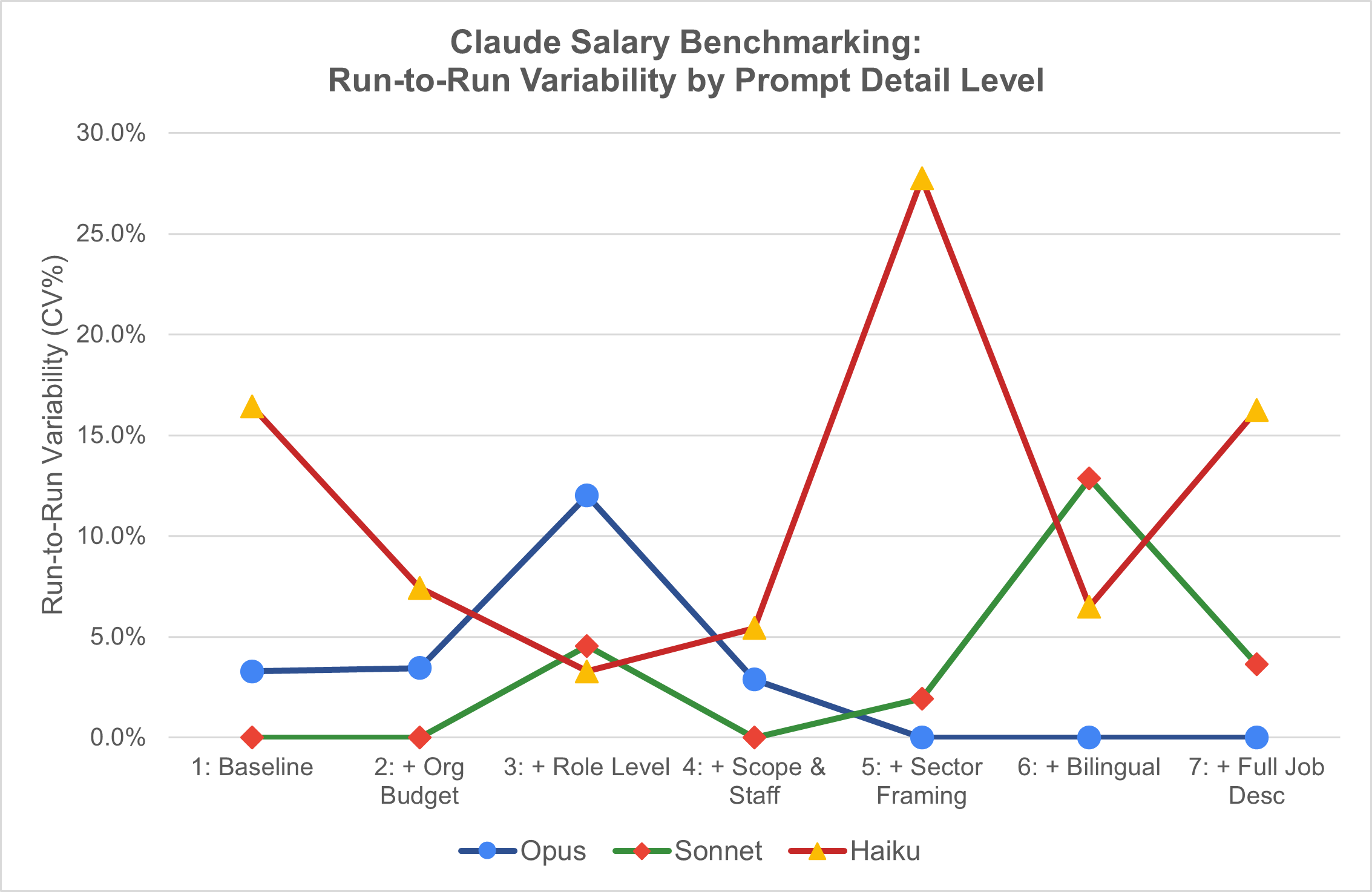
Sonnet 4.6 was the most reliable: just 7% CV (coefficient of variation, a measure of how spread out the results are) across all runs, with 3 out of 7 prompts returning identical midpoints across sessions. Opus was close at 8.9% CV with 3 perfect matches on different prompts.
Haiku was a different story: 18% CV, zero perfect matches, and a worst-case swing of $61,000 between sessions on the same prompt. If you’re using the free tier to check your salary, the number you get is essentially a coin flip.
2. Prompt detail has a Goldilocks zone
More context doesn’t mean better answers. The tightest cross-model agreement came from moderately detailed prompts (Runs 2 through 4: org budget, role level, team scope) with CVs of just 6.0–6.3%.
Adding sector-specific framing (Run 5) caused variability to jump to 22.6%, driven by Haiku returning $186K when the other models said $108K–$120K. And pasting a full job description (Run 7) made things worse, with CV jumping to 21.2%. More detail gave models more surface area to disagree on, not less.
The sweet spot? Include org budget, role level, reporting line, and team size. Stop there.
3. Ask the same question tomorrow, get a different answer
The most unsettling finding: identical prompts in separate incognito sessions produced different answers. Opus and Sonnet averaged a $5,000 shift (4–5%) between sessions, but swung up to $18K–$20K on their worst prompts. Haiku averaged a $23,000 shift, with a worst case of $61,000.
Even the perfect prompt has built-in randomness that no amount of engineering eliminates.
The Most Reliable Configuration I Found
Model: Sonnet 4.6 (paid, mid-tier)
Prompt level: Run 4, including org budget, role level, reporting line, team size, and portfolio scope
Result: $115,000 midpoint on both sessions, perfectly reproducible
Runner-up: Opus on sector framing and bilingual prompts (Runs 5–6) returned identical midpoints of $120K–$126K. The premium model stabilizes, but only with very specific sector context.
So Should You Use AI to Benchmark Your Salary?
AI is useful as a conversation starter, not a source of truth. If Claude says your midpoint is $115K and you’re making $85K, that’s a signal worth investigating. But it’s not evidence.
What AI can do well: give you a rough sanity check on order of magnitude, help you think through what factors affect your market value, and generate a starting framework for a compensation conversation.
What AI cannot do: replace actual compensation survey data (Radford, Mercer, Compdata, or nonprofit-specific sources like the FairPay Collaborative), give you a defensible number for a negotiation, or be consistent enough to compare across colleagues.
The Bottom Line
If your salary is $100,000, Claude’s best guess for your market rate could land anywhere from $95,000 to $186,000. Even with paid models and a well-crafted prompt, you’re looking at a ±5–20% margin of error.
That’s not “wrong” in the way a broken calculator is wrong. It’s unreliable in the way a friend who “has read the Wikipedia article” is unreliable. Useful for orienting yourself. Dangerous if you treat it as ground truth.
Methodology: 42 total observations (7 prompt levels × 3 Claude models × 2 independent sessions). Each session used a fresh incognito browser window. Opus and Sonnet tested via paid Claude Max subscription; Haiku via free account. All prompts asked for fixed Range Min, Midpoint, and Range Max values. Analysis focused on midpoint as the primary reliability metric.
March 2, 2026
Question: Can LLMs produce market benchmarks that are reliable enough to inform real compensation decisions (and if so, where does it break down)? Put another way: has AI gotten "good enough" to replace compiled surveys or comp databases?
TL;DR In a pilot test using 15 common nonprofit roles scoped to San Francisco nonprofits (25–50 FTE), LLM-generated market medians tracked “paper survey” benchmarks closely (high agreement on role ordering and relative differentials), but diverged more from leading national compensation databases, especially for executive roles. In other words, LLMs do a good job ranking pay rates between jobs but are probably less accurate at giving you a true “range” in the absence of other org context. My recommendation: use LLMs for quick triangulation (“do Controller or Sr. Director of Finance typically pay more at Oakland nonprofits?”), job-matching sanity checks, and early range development. Do not use them as a single source of truth for pricing decisions, and always calibrate with at least one traditional benchmark source, especially above the director level.
Context
If you’re a CPO or HR leader, you already know the pain points of market benchmarking:
- Comp databases or surveys are expensive and often sold in bundles
- Job matching takes time and still produces “depends who you ask” answers
- Scope and leveling differences can swamp the number you hoped would be definitive
- You need something fast enough to support real decisions, but defensible enough to stand up in leadership and comp committee conversations
At the same time, large language models (LLMs) can produce salary benchmarks in seconds. That’s both enticing and risky. The real question isn’t “can an LLM give you a number?” It’s “how accurate are those numbers compared to traditional sources?”
To explore this, I ran a small pilot comparing LLM-produced market medians to two categories of traditional benchmarking sources:
- Survey-style benchmarks (compiled survey outputs): I pulled two leading national or regional surveys typically used by Bay Area nonprofits
- Database-style benchmarks (leading national comp databases): I pulled from three widely used national compensation databases
I then ran three LLMs (ChatGPT, Claude, and Gemini) with a consistent market scope: San Francisco/Bay Area, nonprofits, 25–50 FTE, P50/median pay as the anchor point.
See the Appendix below for an example of the data gathered for a “Development Manager” role.
A quick note on language: for the purposes of this analysis, “accuracy” means “agreement with traditional sources under a comparable set of market parameters.” In compensation benchmarking, there is rarely a single “true” number; there are multiple legitimate answers depending on how the cut is defined and how the job is matched.
Method in Plain English
For each role, I created “consensus” estimates to reduce single-source noise:
- LLM consensus: average of the three LLM medians
- Survey consensus: median of the “paper survey” medians
- Database consensus: median of the database-style medians
Then I compared the consensus estimates as scatter plots (one dot per role). I used R² as a quick measure of agreement, a 45-degree line (perfect agreement) to show level differences, a fitted regression line to show systematic bias, and outlier labeling to identify which roles drove divergence.
This is deliberately not a “gotcha” test, but a practical question: if you’re benchmarking in the real world, does the LLM output behave like market data you already recognize?
Results: What the Data Showed
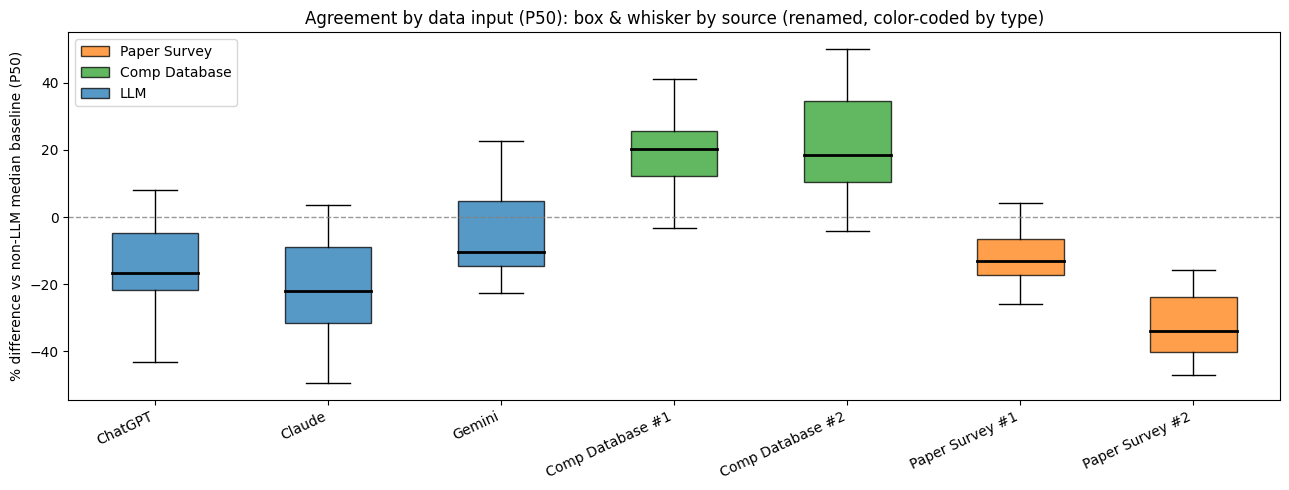
1. Paper surveys vs. LLMs: strongest agreement — R² = 0.94. Across roles, LLMs tracked survey-style medians closely. If a role priced higher in surveys, it tended to price higher in LLM outputs too.
2. Paper surveys vs. database-style benchmarks: solid agreement, more spread — R² = 0.88. Even traditional sources diverged meaningfully, especially as roles moved up-market in scope. This is a useful reminder that benchmarking tools are not interchangeable without careful cut alignment.
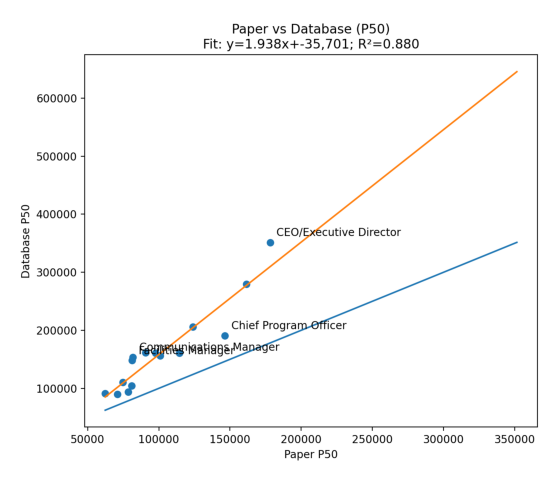
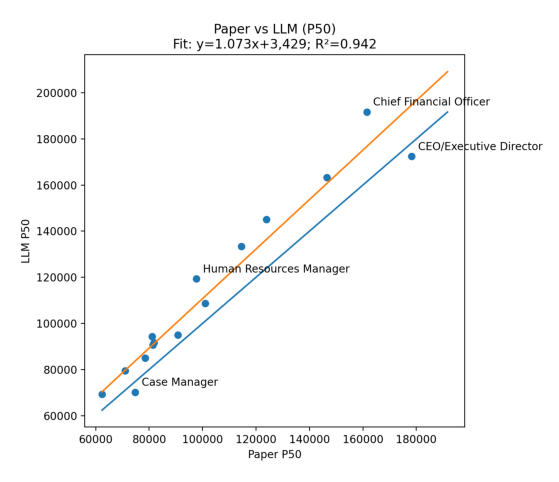
3. Database-style benchmarks vs. LLMs: weakest agreement — R² ≈ 0.77. LLMs did not reproduce database-style patterns as reliably, particularly at the senior end.
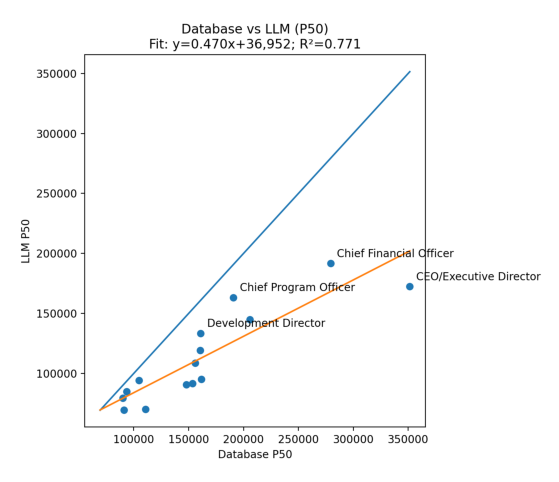
Where disagreement clustered: The biggest divergence showed up in executive and top-of-house roles (CEO/ED and CFO equivalents). Mid-level manager and professional roles were more stable across sources.
What that pattern usually means in practice: Executive roles have the highest variance in real life because scope is typically more ambiguous, incentives and total cash conventions vary, and organization-size elasticity is larger. Traditional databases often encode leveling and job architecture conventions in ways that LLM prompting does not consistently capture unless scope is specified very tightly. For example: you will benchmark a “VP of Finance” differently depending on whether the organization also has a CFO.
Interpretation: What This (Might) Mean for LLM Accuracy
The headline takeaway is not “AI is/is not ready to replace comp databases.” The takeaway is: LLMs can be directionally reliable for benchmarking common roles when scoped well, but they are more fragile than traditional sources when scope and leveling complexity increase.
LLMs appear strong on relative pricing. Across roles, LLM outputs tracked the “shape” of the market well against survey-style benchmarks. That’s useful because many real decisions rely on relative relationships — questions like:
- Are we preserving reasonable internal differentials?
- Does a draft range architecture look broadly aligned with market trends?
- Should we post a higher or lower range for a new role compared to an existing one?
LLMs appear weaker on database-style “cut fidelity.” Databases behave differently from survey-style sources because they embed specific job-leveling conventions, location factors, sector, org-size, and embedded job-matching logic. LLMs can approximate that, but ultimately they are a “black box” in the same way that comp databases can be — with even less insight into the methodology for how that particular number or range was created.
Executive roles are the “your mileage will vary” zone. If you’re a seasoned comp pro, the data in this little pilot study behaved as you might expect: the higher the scope ambiguity, the more sources diverged. If you’re setting executive pay, the cost of being wrong is large and the defensibility bar is high. LLMs can help you develop a directional hypothesis about pay rates, but not final decisions. I might use an LLM to get a general sense for “Nonprofit CEO pay in Louisville for orgs around $10M,” but wouldn’t use it for structure design or individual pay decisions.
Recommendations for HR Leaders and Consultants
Consider using LLMs for:
- Quick triangulation when you’re early in a project
- Role definition and job-matching sanity checks, especially when titles are misleading (“this role is titled Director but JD reads more like a Manager”)
- Drafting a first-pass range hypothesis for common roles, to be validated
- Identifying where scope questions matter most — if an LLM “range estimate” swings a lot when you change a particular variable, it is probably flagging a scoping problem
Do not use LLMs as a single source of truth for:
- Executive compensation ranges or placement decisions
- Any situation where you need to defend the benchmark to a board or comp committee
- Roles with high scope variability (CFO/Controller, COO, heads of development, heads of product/program) unless you have a tight scope spec and at least one traditional anchor point
How to make LLM benchmarking meaningfully safer:
- Lock the market definition in writing (geo, sector, org size, pay basis) and reuse it verbatim
- Run multiple models, not one (e.g., ChatGPT and Claude); look for convergence rather than a single answer
- Use the paid version of these tools (free versions are much less reliable)
- Calibrate: anchor to one trusted benchmark point from a traditional source, then use LLMs if you need to fill gaps
- Treat LLM outputs as hypotheses; test by adjusting one variable at a time to see what’s driving the number
- Keep an audit trail: prompts used, the assumptions you gave the model, and the outputs along the way
- Make sure you’ve turned off the “use my data for training” option in whichever model you use
Closing Thought
LLMs are already useful in benchmarking workflows; the mistake is treating them as a replacement for market data. In my “little pilot,” they performed surprisingly well against paper survey benchmarks under a defined market cut, and less well against database-style outputs. Unsurprisingly, the gaps were biggest with executive positions — where identifying the “right” pay rates are hardest anyway.
If you approach LLMs as a speed tool for triangulation and scoping, they might add real value. If you treat them as the final answer, you will eventually get burned — most likely at the executive level or in roles where scope is ambiguous.
If you’re thinking through how to integrate LLMs into your benchmarking workflow in a way that’s practical and defensible, I’m happy to compare notes; this is an area I’m actively developing thinking on. ben@thrulinecomp.com
Appendix: Sample Role Comparison — Development Manager
Market Parameters: San Francisco/Bay Area, Nonprofits, 25–50 FTE
| Source Type |
Source (masked) |
Market Scope Used |
P50 (median) |
Notes |
| LLM |
ChatGPT |
San Francisco; Nonprofit; 25–50 FTE |
$95,000 |
Prompted to target scope |
| LLM |
Claude |
San Francisco; Nonprofit; 25–50 FTE |
$88,000 |
Prompted to target scope |
| LLM |
Gemini |
San Francisco; Nonprofit; 25–50 FTE |
$102,000 |
Prompted to target scope |
| Survey-style |
Survey A (national nonprofit survey) |
Closest available cut |
$101,503 |
Masked source name |
| Survey-style |
Survey B (regional nonprofit survey) |
Closest available cut |
$80,000 |
Masked source name |
| Database-style |
Comp database 1 (leading national platform) |
San Francisco / org-size cut |
$141,100 |
Masked source name |
| Database-style |
Comp database 2 (leading national platform) |
San Francisco / org-size cut |
$181,971 |
Masked source name |
| Consensus |
LLM average |
N/A |
$95,000 |
Average of 3 LLM medians |
| Consensus |
Survey median |
N/A |
$90,752 |
Median of 2 survey-style medians |
| Consensus |
Database median |
N/A |
$161,536 |
Median of 2 database medians |
| Spread |
Range across all sources |
N/A |
$101,971 |
Max minus min across all sources |
February 25, 2026
I'm excited to launch this blog as a space to share insights, research, and practical guidance on compensation design for mission-driven organizations.
Over the coming months, I'll be writing about topics like:
- How to conduct a meaningful pay equity analysis
- Building compensation philosophies that reflect your values
- Navigating market benchmarking for nonprofit roles
- Communicating pay decisions with transparency and trust
Stay tuned for more, and feel free to reach out if there's a topic you'd like me to cover.